 Skip to content
 services@innblac.com
 +8613802505081
How to Tell Pure Denim from Stretchy Denim Jeans
- by Lucy Zhou
The Textile Audit: How to Tell Pure Denim From Stretchy Denim Jeans for Premium Private Labels
For independent fashion founders, private label creative directors, and contemporary boutique buyers, auditing the raw material substrate of your lower-body collection defines your label's technical authority. In the premium streetwear landscape, the composition of your fabric is not merely a detail on a care label—it dictates the entire longevity, structural silhouette, and retail value of the garment. Sourcing managers frequently fall into the "Inelastic Trap." They order bulk inventory based on a digital tech pack or a fluid sample, only to receive a production run that either sits completely stiff like a cylinder or bags out formlessly at the knees after a few consumer wears.
To protect your brand’s retail value, build consumer trust, and command premium $140+ boutique markups, you must master the technical mechanics required to differentiate pure denim from stretchy denim jeans during factory procurement.
The Material Anatomy: Weave Density versus Elastane Blends
The primary differentiator between pure and stretch denim lies in the raw fiber engineering and yarn spinning methods executed at the textile mill.
- The Architecture of Pure Denim: True premium pure denim is woven from 100% ring-spun cotton yarns. It features a traditional, rigid twill construction—typically a 3x1 right-hand twill—where the heavy cotton threads are packed tightly together. This creates a dense structural skeleton that conforms to the wearer's body over time through natural friction rather than artificial elasticity, capturing a distinct vintage character that synthetic blends cannot replicate.
- The Blueprint of Stretchy Denim: Conversely, stretchy denim introduces polyurethane elastomers—such as Lycra, Spandex, or Elastane—into the weft yarns, typically ranging from 1% to 5% of the total fiber composition. While this addition provides immediate comfort and step-in flexibility for mass-market mall brands, it compromises the structural integrity required for high-street silhouettes.
The Structural Defect: Why Stretch Denim Destroys High-Street Silhouettes
Choosing the wrong fabric substrate will instantly destroy the intended silhouette of modern baggy, oversized, or stacked trousers during bulk production.
- The Silhouette Collapse: Contemporary streetwear shapes—including relaxed balloon fits, extended stacked legs, and heavy multi-pocket utility cargo jeans—rely entirely on the fabric's self-supporting mass. If your manufacturer utilizes a stretch denim blend, the fabric lacks the necessary rigidity. Instead of pooling crisply over the consumer's sneakers or holding a structured, boxy volume along the leg profile, stretch denim drags downward under its own elastic tension, bagging out severely at the knees and thighs.
- The Heavyweight Benchmark: To achieve the uncompromising drape demanded by the premium market, your tech packs must explicitly mandate rigid, high-density textiles—specifically 14oz to 16oz heavyweight 100% combed cotton denim. This extreme weight holds its architectural form indefinitely, ensuring your designs retain three-dimensional volume even after intensive consumer wear. To inspect the peak of this heavy-duty rigid manufacturing caliber, explore the INNBLAC Premium Custom Apparel Collection.

The Factory Audit: Four Technical Tests to Verify Rigid Purity
When auditing raw fabric swatches or initial factory prototypes, do not rely on the supplier's word alone. Execute these four industrial tests to verify you are receiving true pure denim:
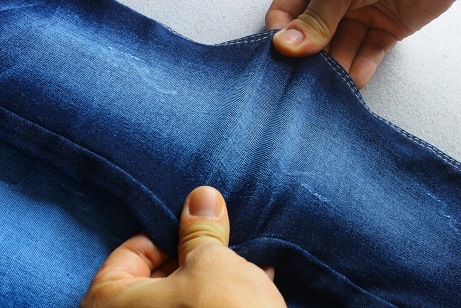
- The Tensile Extension Test: Grasp a 10cm section of the fabric along the cross-grain (weft). Apply firm outward pressure. Pure 100% cotton denim will offer immediate, unyielding resistance with zero mechanical give. Stretchy denim will easily elongate by 15% or more and snap back instantly when released.
- The Flame/Burn Audit: Extract a few structural yarns from the weft of the fabric swatch and ignite them with a clean flame. Pure cotton denim will burn cleanly, smell like burning paper, and leave a soft, gray, crushable ash. If the yarn contains elastane or polyester stretch blends, it will melt, produce a chemical acrid odor, and form a hard, black, plasticky bead at the tip.
- The Hand-Feel Density Test: Pure heavyweight denim possesses a distinct, dry, slightly abrasive, and cool hand-feel due to the tightly packed natural cotton fibers. Stretch denim, even when heavily washed, retains a faint, synthetic micro-slickness or a spongy, rubberized bounce when compressed in your palm.The Structural Fold Memory: Fold the fabric swatch sharply in half and press down firmly with your thumb. Pure rigid denim will hold a crisp, defined, semi-permanent crease line due to the memory of the heavy cotton fibers. Stretchy denim will fight the fold, bowing outward and smoothing itself out almost immediately.
Logistical Shielding: Securing Gross Margins via Landed DDP Models
Regardless of whether your private label focuses on rigid raw essentials or heavily processed vintage washes, shipping heavy-gauge bulk orders introduces immense logistical volatility. Because 15oz premium rigid denim utilizing heavy metal shank buttons and reinforced rivets carries substantial physical mass, international freight costs scale rapidly.
Sourcing your private label inventory on traditional FOB (Free On Board) terms leaves your business legally and financially exposed. Volatile international ocean and air freight rates can destroy your cash flow. More importantly, as the US/UK importer of record, you are hit with complex customs clearance fees, port handling charges, and unpredictable apparel input tariffs. A low FOB factory quote can easily skyrocket by 40% once landed at your warehouse, erasing your projected quarterly profit margins.
The professional supply chain solution is exclusively enforcing a Delivered Duty Paid (DDP) sourcing model.
Under a DDP framework, your manufacturing partner integrates the premium pure cotton denim sourcing, the precision pattern grading, the heavy-duty hardware stamping, all international freight forwarding, and all destination customs clearance into a single, transparent price per unit. You receive your bulk production boxes directly at your brand warehouse or boutique doorstep with zero surprise invoices or hidden port fees, locking in your exact gross margins before the first production needle even drops.
Conclusion: Form vs. Utility—Protect Your Private Label Fabric Foundation
Choosing pure denim over cheap stretch substitutes shouldn't be a game of chance played with unverified trading agents or low-grade wholesale catalogs. To dominate the premium streetwear market, your supply chain must seamlessly deliver elite fabric weights alongside a transparent, high-velocity logistics infrastructure.
- Incorporate Pure Rigid Denim If: Your brand positioning demands aggressive high-street styling, dramatic sneaker-pairing silhouettes, and a heavy, textured, vintage-washed aesthetic that holds its form and commands maximum design authority.
- Incorporate Stretch Denim Only If: Your label targets mass-market, slim-fitting lifestyle comfort essentials where structural volume and premium boutique pricing are not priority metrics.
- Request the Heavyweight Denim Sample Kit: Feel the immense structure of our 15oz premium 100% cotton denim and inspect our precise stitching and wash variations in person.
- Get Your Landed US/UK DDP Production Quote: Secure transparent, all-inclusive pricing with fast transit times locked into your private label budget.
- Ready to elevate your street clothing drops with the ultimate custom pure denim?
Visit INNBLAC.COM to source your premium custom jeans collection today.
- Posted in:
- denimGuide
- denimJeans
- denimQuality
- jeansFabric
- pureDenim
- stretchDenim
